How I Found... The Way

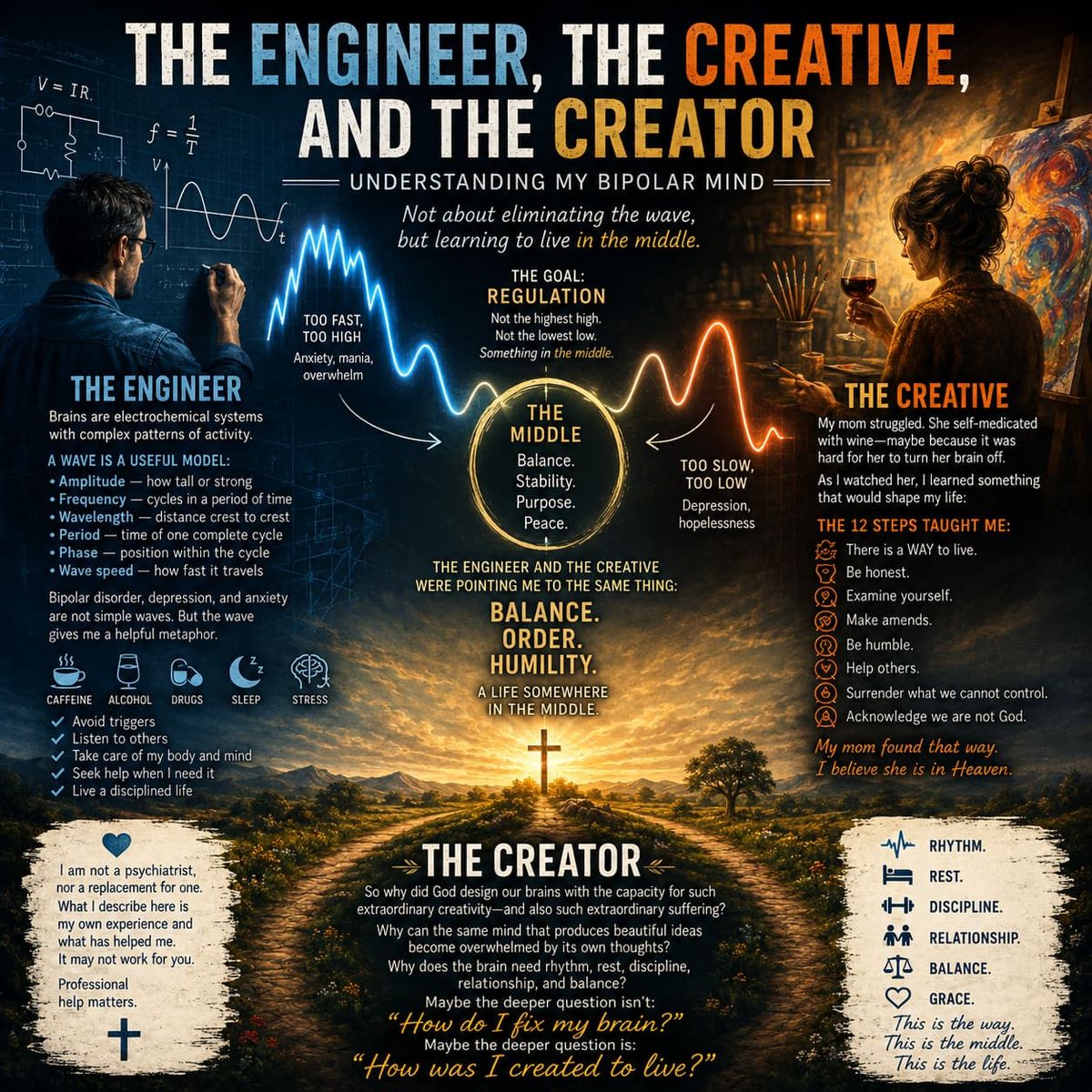
I am not a psychiatrist, nor am I a replacement for one. What I describe here is my own experience and what has helped me. It may not work for you. Mental health conditions such as bipolar disorder are complex, and professional medical care matters.
When I was diagnosed with bipolar disorder, I had no idea there was anything "wrong" with my brain.
I thought being creative, stressed, energetic, and depressed was simply what I had to deal with to survive in the modern jungle.
When I was depressed, I medicated myself with copious amounts of caffeine. Sometimes that seemed to push me in the opposite direction—I felt very good. Too good. My thoughts raced. Ideas came from everywhere. I felt incredibly creative, but it was difficult to point that creativity at any one thing for very long.
I wanted to be good at everything.
So I became a jack of all trades and a master of none.
Looking back, I can see two very different influences in my family. My mom was highly creative and struggled deeply with her mental health. My father is a mathematician and engineer.
So when I started trying to understand my own mind, I found myself approaching it from Three Directions.
The Engineer, The Creative
And eventually, The Creator.
The Engineer
The engineer in me wants to understand how this thing works.
Our brains are electrochemical systems. Billions of neurons communicate through electrical impulses and chemical messengers, forming incredibly complex patterns of activity.
One way I like to visualize those patterns is through waves.
Remember high school math?
A wave has:
- Amplitude — how tall or strong the wave is.
- Frequency — how many cycles occur in a period of time.
- Wavelength — the distance between corresponding points, such as crest to crest.
- Period — how long one complete cycle takes.
- Phase — where one wave is in its cycle relative to another.
- Wave speed — how quickly the wave travels.
Now, bipolar disorder, depression, and anxiety obviously cannot be reduced to a simple sine wave. The actual neuroscience is vastly more complicated than that.
But the wave gives me a useful metaphor.
My goal isn't to live at the highest possible point of the wave.
And it isn't to live at the lowest.
It's regulation.
For me, that means paying attention to things that can push my mind out of balance—caffeine, alcohol, drugs, lack of sleep, stress, and other triggers. It means listening to the people around me when they notice something I don't. It means taking care of my body and mind, seeking professional help when I need it, and trying to live a disciplined life.
I'm looking for something... in the middle.
The Creative
My mom really struggled.
It took me a very long time to understand what I could learn from her struggle.
She didn't self-medicate with caffeine the way I did. She self-medicated with wine. Looking back, I wonder whether part of the reason was that it was simply difficult for her to turn her very creative brain off.
As I watched her struggle with alcohol, something else was happening.
At a very young age, I was being introduced to the Twelve Steps.
And buried inside those Twelve Steps was an idea that would become incredibly important to me:
There actually is a way to live.
A way that requires honesty.
Self-examination.
Making amends.
Humility.
Helping others.
Surrendering what we cannot control.
And acknowledging that we aren't God.
My mom eventually found that way. And I believe she is in Heaven.
Years later, I began to realize something:
The engineer and the creative were pointing me toward the same thing.
Balance.
Order.
Humility.
A life that isn't governed by every impulse, every high, every low, every fear, or every desire.
A life somewhere in the middle.
And that's where the third part of this story begins.
The Creator
So why did God design our brains with the capacity for such extraordinary creativity—and also such extraordinary suffering?
Why can the same mind that produces beautiful ideas become overwhelmed by its own thoughts?
Why does the brain need rhythm, rest, discipline, relationship, and balance?
And why does so much ancient spiritual wisdom seem to point toward many of those same things?
Maybe the question isn't simply:
"How do I fix my brain?"
Maybe the deeper question is:
"How was I created to live?"