The Case for Decentralized Giving: The Angel Tree

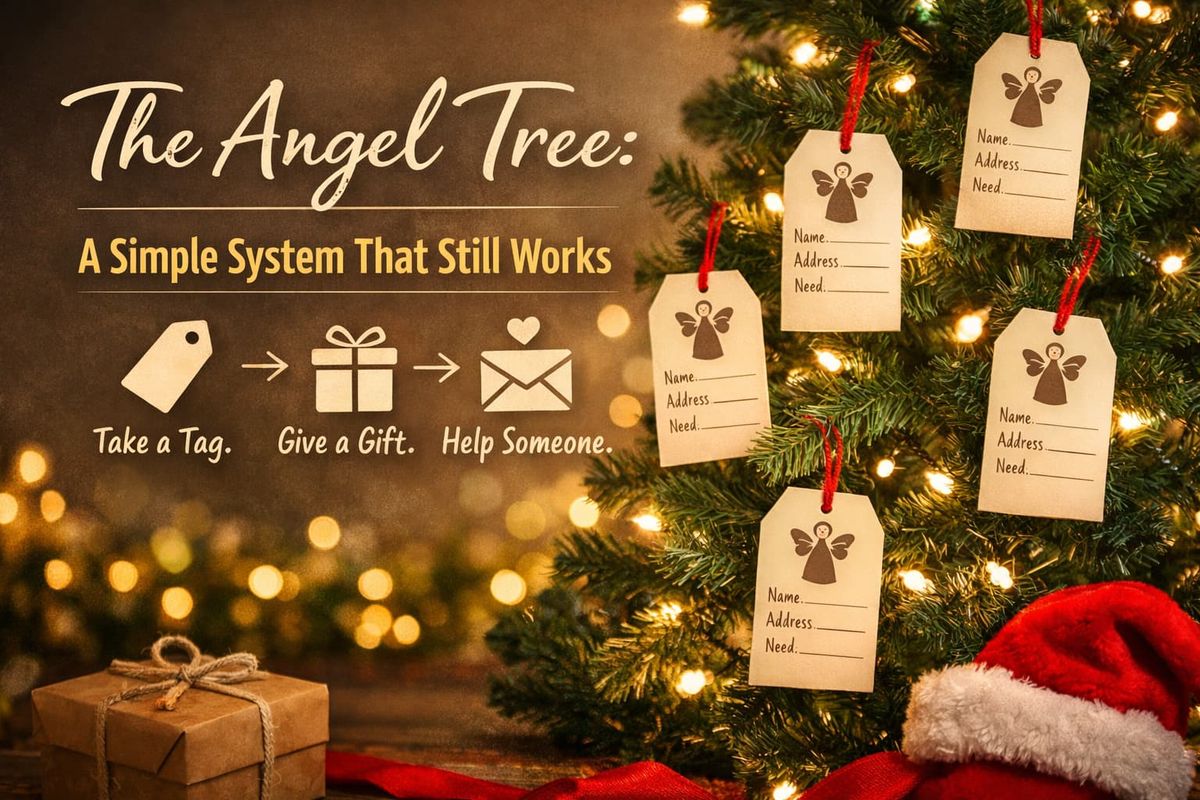
For those of you that don't know what an angel tree is: It’s a Christmas tree set up during the holidays with something called angel tags. The tags have just four simple pieces of information: the person’s name, address, and what they need (not want) for Christmas. So not: cash, PlayStations, video games, or televisions.
The point of the tree is for people in need to be able to place their tags on the tree—and for those who feel called to give, to pull a tag and ship a gift anonymously to someone who needs it.
There is no giant corporate organization required for this—just a tree and some paper tags.
And that’s the point.
We’ve somehow convinced ourselves that helping people has to be complicated. That it requires infrastructure, approvals, fundraising campaigns, overhead, staff, systems, and reports. But the angel tree quietly reminds us of something much simpler:
People can take care of people.
No branding.
No spotlight.
No “look at me.”
Just quiet generosity.
There’s something powerful about the anonymity of it too. The giver doesn’t know the full story. The receiver doesn’t know who helped them. There’s no transaction, no expectation, no follow-up email.
Just… provision.
In a world where everything feels scaled, optimized, and monetized, the angel tree feels almost rebellious.
It says:
- You don’t need permission to help.
- You don’t need a budget to make an impact.
- You don’t need a system to show up for someone else.
You just need to care—and to act.
I’ve seen firsthand that when you remove the friction, people step up.
You don’t need to convince people to be generous. You just need to give them a clear, simple path to do it.
A tag.
A need.
An address.
That’s it.
Maybe the takeaway isn’t just about Christmas.
Maybe it’s about how we approach helping people the rest of the year.
What would it look like if we made generosity this simple in our neighborhoods, our churches, our workplaces?
What if instead of building bigger systems, we built clearer pathways?
What if instead of asking, “How do we organize this?” we asked, “How do we remove barriers?”
Because at the end of the day, the angel tree isn’t really about the tree.
It’s about trust.
Trust that if a need is made visible, someone will meet it.
Trust that people, when given the chance, will choose to do good.
Trust that we don’t need to overcomplicate what was never meant to be complicated.
So this year, if you see an angel tree, grab a tag.
And if you don’t see one—maybe that’s your sign to start one.
All it takes is a tree.
And a few pieces of paper.