Should Organizations Incorporate a Democracy?

Watching organizational drama unfold over my career has been fascinating.
Time and again, I’ve seen the same pattern: power concentrates in a single, deeply flawed leader who begins micromanaging every decision. What starts as efficiency turns into control. What looks like leadership turns into bottleneck.
And in the end, it’s bad for everyone—including the leader.
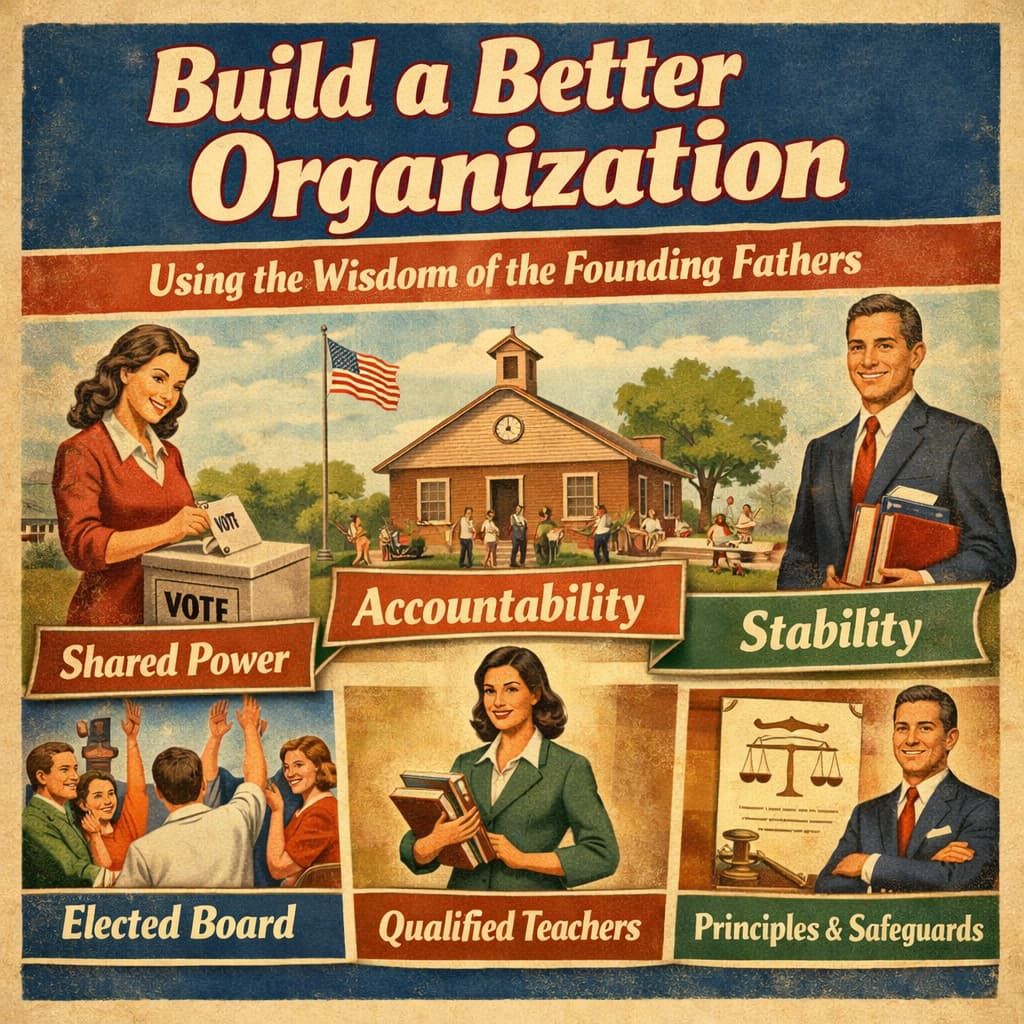
What’s striking is that this isn’t a new problem. Our Founding Fathers understood it well. They built an entire system designed to prevent exactly this outcome—balancing power, creating accountability, and structuring leadership over time.
Yet most modern organizations ignore that wisdom.
So what would it look like to actually apply those principles?
Let’s take a simple example: a private kindergarten.
A Thought Experiment: Democracy in a Kindergarten
Imagine a private kindergarten structured not around a single authority, but around a balanced system of shared governance.
Start with a few assumptions:
- The school operates as a 501(c)(3) nonprofit
- There are two primary stakeholders: parents and teachers
- Funding comes from tuition and community support
Now introduce voting.
Voting Mechanics
Every family gets one vote per household.
Every teacher gets one vote per teacher.
Simple. Clear. Hard to manipulate.
Elections happen annually—but not everything resets at once.
Stability Where It Matters
- Teachers are elected by parents, but serve two-year terms.
- They must meet professional qualifications set by the board.
- They can only be removed early for cause or failure to meet performance standards.
This creates a balance:
- Parents have a voice
- But professionalism is protected
A Board That Governs, Not Controls
A small Board of Directors (5 members) is elected annually by both parents and teachers. The board must consist of 3 elected parents and 2 elected teachers.
Their role is not to micromanage—but to:
- Set direction
- Establish standards
- Ensure accountability
They also define the qualifications and performance expectations for both teachers and leadership.
A Principal With Real Authority—But Not Unlimited Power
The school leader (Principal):
- Must meet board-defined qualifications
- Is elected by the board
- Serves a 4-year term (maximum 2 terms)
This creates something rare in organizations:
- Continuity without permanence
- Authority without unchecked power
If necessary, the board can remove the principal by supermajority vote.
Built-In Safeguards
This system includes protections most organizations lack:
- Performance standards → prevent popularity contests
- Term limits → prevent power from calcifying
- Quorum requirements (60%) → prevent small groups from taking control
- Conflict-of-interest rules → prevent insider decisions
- Emergency authority with review → allow fast action without abuse
What This Actually Solves
Most organizations struggle with three things:
- Bad leadership
- Lack of accountability
- Disengaged stakeholders
This model addresses all three:
- Leadership is elected and removable
- Decisions are distributed, not centralized
- Stakeholders are required to participate
What It Doesn’t Solve
No system can eliminate human nature.
This model still depends on:
- Engaged parents
- Thoughtful voting
- A culture that values excellence over popularity
If people disengage, the system slows.
If people vote emotionally, mistakes happen.
But here’s the difference:
Mistakes don’t last.
The Real Insight
This isn’t about kindergartens.
It’s about a better way to run small organizations.
What we’ve created here is:
A constitutional system for institutions—
where power is shared, leadership is time-bound, and accountability is built in.
The Founding Fathers didn’t design a perfect system.
They designed one that could correct itself over time.
Most organizations never even try.
Final Thought
If you’re building a school, a nonprofit, or even a small team, the question isn’t:
“Who should be in charge?”
It’s:
“What system prevents the wrong person from staying in charge too long?”
That’s the difference between leadership…
and governance.